USE OF A ROTATING LOUDSPEAKER IN
REVERBERATION ROOM ACOUSTIC MEASUREMENTS
Steven R. Sorenson
47660 Halyard Dr.
Plymouth, MI 48170
INTRODUCTION
Reverberation rooms can be used to evaluate random incidence sound absorption of materials as defined by standards such as ASTM C423. These rooms can be of varying shapes but virtually all of these facilities require use of some mechanism to ensure the most diffuse sound field possible. This can consist of features such as stationary baffles suspended within the room or rotating vanes. Many reverberation rooms use stationary loudspeakers though there is at least one facility with the loudspeaker mounted directly on a large rotating vane.
The placement of stationary baffles is not specified in standards such as ASTM C423. They are usually placed in a trial and error fashion until satisfactory results are achieved. Rotating vanes usually take several seconds to complete one rotation. A highly absorptive sample placed in a reverberation room can cause decay times in the room to be on the order of the vane rotation time or less. It is then necessary to make a number of measurements to remove the effect of the location of the vane during each measurement.
A possible alternative to both these methods can be found in the realm of late 1930s musical technology in the form of a rotating loudspeaker, usually known as a Leslie speaker after its inventor, Don Leslie. This loudspeaker consists of two stationary loudspeakers feeding low and high frequency signals to a rotating drum and a rotating horn, respectively. The fast rotation speed of a Leslie speaker is usually close to 400 rpm. This device was evaluated in a reverberation room to assess its suitability in enhancing sound field diffusion for the purpose of acoustic absorption measurements.
BACKGROUND
Research has been done over the years in assessing performance of diffusing elements [1], [2] and in investigating optimal shapes for reverberation rooms [3]. These studies have usually assumed stationary loudspeakers. Diffusion is obtained passively by the placement of diffusers in the room or actively by rotation of a large vane. A rotating loudspeaker will send sound out in all directions in the plane of rotation and provide both amplitude and frequency modulation. Assuming that the basic reverberation room configuration is suitable (e.g., sufficient volume,
reflective walls, temperature and humidity control) it is possible to investigate diffuser performance versus rotating loudspeaker performance. The particular room evaluated has a volume of 200 m3 and is used normally for measurements according to ASTM C423, SAE J1400 and various other standards. Plexiglass diffuser panels are suspended in order to improve diffusion. Suitable correlation of reference samples with other facilities has been established and sound absorption measurements are carried out on a daily basis in this room. The acoustic excitation consists of independent white noise signals from three loudspeakers placed in different corners of the room. Decay times are measured after the noise sources are suddenly shut off.
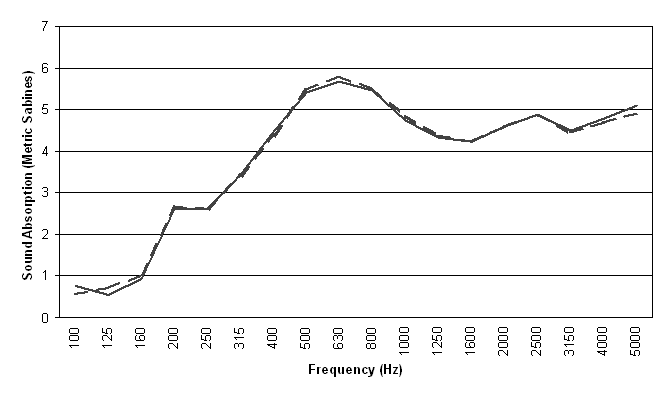 For the purposes
of comparison with a single Leslie speaker, one stationary loudspeaker was
used. Its performance in assessing sound absorption of the test sample was
comparable with that of all three loudspeakers together. See figure 1.
For the purposes
of comparison with a single Leslie speaker, one stationary loudspeaker was
used. Its performance in assessing sound absorption of the test sample was
comparable with that of all three loudspeakers together. See figure 1.
Figure 1. Comparison of sound
absorption of 3" thick foam using three stationary loudspeakers (solid
line) and one stationary loudspeaker (dashed line)
THE LESLIE SPEAKER
The construction of the Leslie speaker is shown in figures 2, 3 and 4 (figures used by kind permission of Clifford A. Henricksen [4]). The upper and lower rotors are driven by independent electric motors using a belt drive system. The actual rotational speeds of the upper and lower rotors are not necessarily identical. The 800 Hz crossover (12 dB per octave) directs low frequency sounds to the lower loudspeaker/rotor and high frequency sounds to the upper loudspeaker/rotor. Note that the actual loudspeakers are stationary. The rotors provide the directional component to the sound, which manifests itself as amplitude and frequency modulation when measured at a specific location. Reflections within the cabinet add a further complexity to the radiated sound. Figure 5 (also used by permission of Clifford A. Henricksen [4]) shows the high frequency polar response of a typical Leslie speaker.
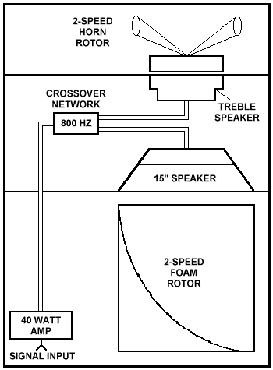
Figure 2. Leslie speaker layout
[4]
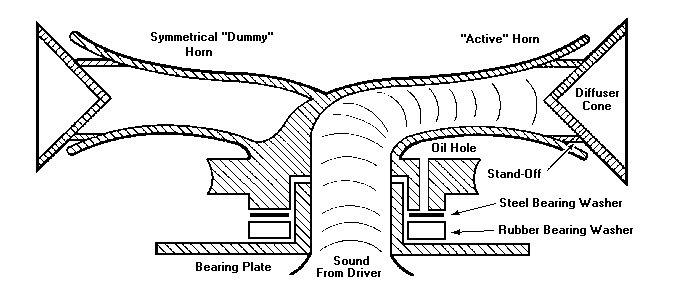
Figure 3. Detail of upper horn
rotor [4]

Figure 4. Detail of lower rotor
[4]
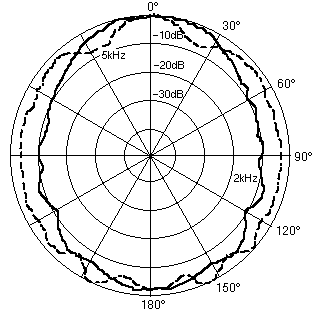
Figure 5. Polar response of Leslie
upper rotor [4]
 The actual
speaker used in the work reported here is a model 44W. Signals were supplied to
the loudspeaker via a Leslie Combo Preamp. Tests were conducted after removing
the back panels which partially cover the rotors. Figures 6 and 7 are a result
of measurements made in a hemianechoic room to establish some of the
characteristics of this loudspeaker. A microphone placed 1 meter from the
center of rotation of the upper rotor measured the response resulting from a 1
kHz test tone supplied to the loudspeaker amplifier.
The actual
speaker used in the work reported here is a model 44W. Signals were supplied to
the loudspeaker via a Leslie Combo Preamp. Tests were conducted after removing
the back panels which partially cover the rotors. Figures 6 and 7 are a result
of measurements made in a hemianechoic room to establish some of the
characteristics of this loudspeaker. A microphone placed 1 meter from the
center of rotation of the upper rotor measured the response resulting from a 1
kHz test tone supplied to the loudspeaker amplifier.
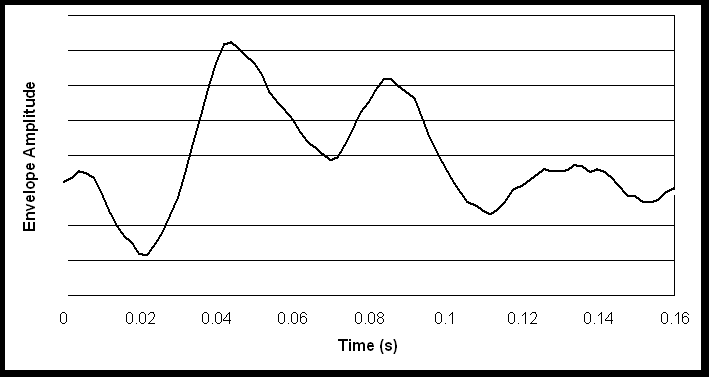
Figure 6. Envelope of Leslie 44W
output at 1m over 10 rotations
Figure 6 shows the envelope of the amplitude of the measured signal over ten complete rotations of the rotor. This curious pattern was regularly repeated. Figure 7 shows a comparison of the spectrum of the input sinusoid and the measured output signal. Actual rotational speed was measured at 376 rpm (upper) and 367 rpm (lower). Side lobes of the measured signal around 1 kHz due to the pattern repetition every 10 cycles are clearly visible. However, FM components at sum and difference frequencies of a single cycle are not clearly predominant over neighboring sidebands.
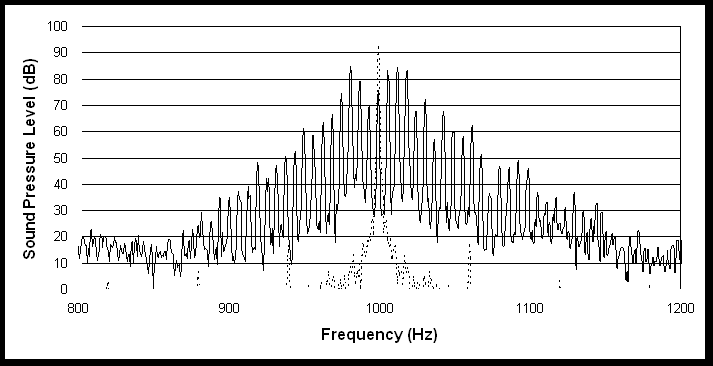
Figure 7. Comparison of input
signal spectrum (dashed line) and output signal spectrum 1m from upper rotor
(solid line)
ABSORPTION MEASUREMENTS
A test sample of 72 ft2 of three inch thick foam was used as a means of comparing excitation methods. Testing was conducted according to ASTM C423. Room temperature and humidity were controlled. In-room measurements were made by a microphone mounted on a boom. The boom was moved to a new position after each measurement in so that acoustic decay measurements in six different locations were obtained. Multiple measurements at each microphone position were averaged. Actual decays were estimated using a B&K 2133 two channel analyzer.
Using the single loudspeaker/diffuser panels in place as a reference to be matched, the following characteristics were noted (see figure 8):
 Mid-frequency measurements (500-800
Hz) with the Leslie speaker were significantly better than those of the single
loudspeaker with no diffuser panels;
Mid-frequency measurements (500-800
Hz) with the Leslie speaker were significantly better than those of the single
loudspeaker with no diffuser panels;
Measurements between 800 and 4000 Hz
for all three methods were quite similar;
Measurement using the Leslie speaker
showed a large drop in measured absorption in the 5000 Hz 1/3-octave band;
200-500 Hz absorption values
determined using the Leslie speaker were too high.
The 5000 Hz dropoff is probably due to the inherent limitations of the Leslie frequency response, though further work is required to determine the optimal position and orientation of Leslie rotation axis in the reverberation room. The lower frequency overprediction of absorption values may be related to the position of the lower rotor (centered approximately six inches off the floor)
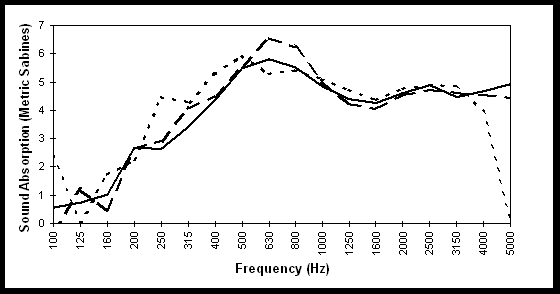 Figure 8. Comparison of measured sound
absorption of foam sample using
Figure 8. Comparison of measured sound
absorption of foam sample using
Stationary loudspeaker with diffuser panels in
room (solid),
Stationary loudspeakers with diffuser panels
removed (long dash) and
Leslie speaker with diffuser panels removed
(short dash)
relative to the surface of the foam sample (three inches high), and again an optimization study of rotating speaker position is required to resolve this.
The performance of the Leslie speaker in leading to accurate mid-frequency absorption measurement is encouraging because this frequency range is strongly affected by the diffuser panels.
CONCLUSION
A rotating loudspeaker such as the Leslie speaker provides a continuously variable directional sound source for reverberation room excitation. Using this excitation, accurate measurements of sound absorption can be made. Further optimization of rotating loudspeaker placement is required. Placement of a rotating loudspeaker in a traditional corner location in a reverberation room can then be an alternative to trial and error placement of diffuser
REFERENCES
- "Effect
of Rotating Diffusers and Sampling Techniques on Sound-Pressure Averaging
in Reverberation Rooms", J. Tichy, P. K. Baade, J. Acoust. Soc.
Am., 56, No. 1, pp. 137-143 (1974)
- "A
Macroscopic View of Diffuse Reflection", B. Dalenback, M. Kleiner, P.
Svensson, J. Audio Eng. Soc., 42, No. 10, pp. 793-807 (1994)
- "Computer
Optimized Design of a Reverberation Room", G. Ebbitt, M. Dinsmore, N.
Rauf, Proc. Noise-Con 94, pp. 857-862 (1994)
4. "Unearthing the Mysteries of the
Leslie Cabinet", C. A. Henricksen, Recording Engineer and Producer,
April, 1981