Wurlitzer Organ Trust of
C/ - The Playhouse Theatre, Glen Eden,
Auckland New Zealand
Our Wurlitzer Organ
Excerpted from The
Unit Orchestra In The “Land Of The Long White Cloud” – A Look At The Theatre
Pipe Organ In New Zealand
By Jelani Eddington, © 2004 RJE Productions LLC
(reprinted with permission)
3/15 Wurlitzer, Opus 1475 – Hollywood
Cinema, Avondale,
Not
surprisingly, the center of gravity of theatre organ activity in New Zealand is
located in Auckland, the country’s largest city of over 1 million
inhabitants. The 3-manual 15-rank
Wurlitzer that now resides in the Hollywood Cinema in Avondale (a suburb of
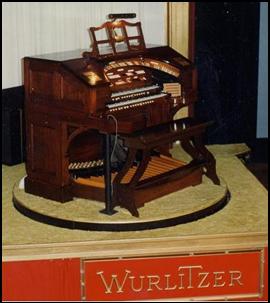
Auckland) began its life as a 2-manual 8-rank Wurlitzer “Model F” Opus
1475. Shipped from Wurlitzer’s North
Tonawanda factory in October 1926, Opus 1475 arrived in New Zealand in December
of that year and was installed in the 1,700-seat Regent Theatre on Auckland’s
Queen Street – the city’s most elegant thoroughfare.
The
installation of the instrument was not completed in time for the official
opening of the theatre in December 1926, and the organ was not heard publicly
until February 1927 in a dedicatory concert played by American organist Eddie
Horton. The theatre engaged Mr. Horton
as house organist for the next year, followed by Australian organist Knight
Barnett. As was often the case, the
advent of the “talking” pictures in the 1930s temporarily silenced the
instrument, and it was very rarely heard in public. Additionally, with the arrival of the much
larger Wurlitzer Style 260 “Special” at the Civic Theatre only a few doors up
the street from the Regent (see below), the novelty of the Regent Wurlitzer all
but vanished.
 After
sitting virtually unplayed and unheard for several
years, the instrument was offered for sale in 1944, and the parents and pupils
of Hutt Valley High School, located in a dormitory suburb of New Zealand’s
capital city, Wellington, purchased the instrument. The organ was installed in the school’s
assembly hall where it became a feature of the music department and played for
various school functions for many years.
Sadly, in 1968 a deadly tropical cyclone struck the area which, at its
apex, blew apart a portion of the roof of the school hall, exposing the
instrument to torrential rains and wind.
(In fact, this same storm was responsible for the sinking of an
inter-island ferry, the Wahine, at the entrance to
After
sitting virtually unplayed and unheard for several
years, the instrument was offered for sale in 1944, and the parents and pupils
of Hutt Valley High School, located in a dormitory suburb of New Zealand’s
capital city, Wellington, purchased the instrument. The organ was installed in the school’s
assembly hall where it became a feature of the music department and played for
various school functions for many years.
Sadly, in 1968 a deadly tropical cyclone struck the area which, at its
apex, blew apart a portion of the roof of the school hall, exposing the
instrument to torrential rains and wind.
(In fact, this same storm was responsible for the sinking of an
inter-island ferry, the Wahine, at the entrance to
Wellington
Harbor, with the tragic loss of 51 lives.)
Due
to the significant damage to the Wurlitzer, the school considered the
instrument to be unplayable and sold it to Wellington businessman and organ
enthusiast Lindsay Anderson who in turn sold the instrument to Auckland
enthusiast Les Stenersen in 1978. Mr. Stenersen, with
the assistance of the late Mr. Jan Grefstad (owner of
the Hollywood Cinema), Mr. John Parker (an organ builder from Sydney,
Australia, then resident in New Zealand), the Kiwi Chapter of the American
Theatre Organ Society, and a host of volunteers, brought the organ back to
Auckland in August of that year and began the process of installing the
instrument in the Hollywood Cinema.
[FN1]
The
instrument was repaired and painstakingly rebuilt under the direction of John
Parker. Because the Hollywood Cinema was
used exclusively for motion pictures, it was possible for the instrument to be
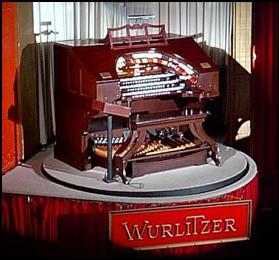
installed in three chambers (Main, Solo, and Percussion) behind the movie screen. The console was situated to the left of the
proscenium on a turntable lift. The
opposite side of the proscenium houses a Wurlitzer upright piano console which
was once the piano-console organ at the Cozy Theatre in Masterton (see below).
In
addition to the original eight Model F ranks (Tuba Horn, Open Diapason, Tibia Clausa, Violin & Celeste, Clarinet, Vox
Humana, and Concert Flute), four more ranks were added, including a Solo
String, Tromba, and a “pseudo” Kinura
and Post Horn. Mr. Anderson retained the
organ’s original toy counter and percussions before the instrument was returned
to Auckland, and, accordingly, the traps from Cozy Theatre Wurlitzer were
incorporated into the Hollywood organ.
Additionally, Wellington organ enthusiast Michael Woolf loaned a
Glockenspiel and Xylophone from his residence installation (see discussion of
the Nelson Paramount below).
The
installation and restoration of the instrument was completed in late 1982, and
November of that year saw the re-inaugural concert with Australian organists
Tony Fenelon and Margaret Hall at the console.
Following this gala re-opening of the instrument, the Hollywood
Wurlitzer was used very regularly and could be heard in as many as eight public
concerts each year.
 In
1993, Mr. Stenerson announced his intention to sell
the Wurlitzer, and with the spectre of the instrument
being sold for parts overseas, a group of eight enthusiasts formed the
Wurlitzer Organ Trust of Auckland (WOTA) – a charitable trust that purchased
the instrument from Mr. Stenerson and assumed responsibility
for its preservation and maintenance.
Once the Trust was established, the first priority was to focus on the
condition of the instrument. Since 1984,
the instrument had been a very active organ with 6-8 concerts each year and was
in need of refurbishment and upgrading.
In
1993, Mr. Stenerson announced his intention to sell
the Wurlitzer, and with the spectre of the instrument
being sold for parts overseas, a group of eight enthusiasts formed the
Wurlitzer Organ Trust of Auckland (WOTA) – a charitable trust that purchased
the instrument from Mr. Stenerson and assumed responsibility
for its preservation and maintenance.
Once the Trust was established, the first priority was to focus on the
condition of the instrument. Since 1984,
the instrument had been a very active organ with 6-8 concerts each year and was
in need of refurbishment and upgrading.
The
first phase of the renovation included locating a full set of percussions to
replace those loaned by Mr. Woolf. With
the assistance of Russ Evans from Seattle, four Wurlitzer percussions (the
Glockenspiel, Chrysoglott, Xylophone, and Chimes)
were obtained, restored, and installed, and the units on loan were returned to
Mr. Woolf. In addition, WOTA was able to
re-acquire the original toy counter and that had been retained by Mr. Anderson,
and those traps were reunited with Opus 1475.
Moreover, the Kinura and Post Horn were
replaced with more suitable ranks, the Solo String was replaced by a pair of Salicionals, and a Trumpet was incorporated into the
instrument. With the recent installation
of an Orchestral Oboe, the Hollywood Wurlitzer is now complete at 15 ranks.
The
second phase of the restoration came with the rebuilding of the console, as the
organ had literally outgrown its original two-manual console. To this end, and again with the assistance of
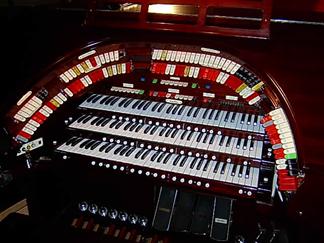
Russ Evans, a three-manual Style 235 Wurlitzer console was located, originally
from Opus 1256 that had been shipped to Loew’s Theatre in Norfolk,
Virginia. John Parker rebuilt the
console and modernized the specification. John Andrews, also of Sydney, installed
an electrified combination action with seven levels of memory, plus a complete
solid-state organ relay to replace the original pneumatic relay. The organ’s original two-manual console and
relay were acquired by Michael Woolf in Wellington to control his residence
organ.
 In May 1998, the newly refurbished console and relay
arrived in Auckland. The premier concert
series took place over the course of a three-month period between June and
August of that year with organists from around the world, including Ken Double
from the United States, Chris Powell, from the United Kingdom, and Margaret
Hall, from Australia.
In May 1998, the newly refurbished console and relay
arrived in Auckland. The premier concert
series took place over the course of a three-month period between June and
August of that year with organists from around the world, including Ken Double
from the United States, Chris Powell, from the United Kingdom, and Margaret
Hall, from Australia.
Since
that time, the Hollywood Wurlitzer has become a focal point of theatre organ
activity in New Zealand, regularly welcoming numerous artists from around the
world. In fact, the Hollywood Wurlitzer
is often the starting point for organists embarking on tours throughout
[FN1] For an account of the return of
the Regent Wurlitzer from Wellington to Auckland, see Dawe, Norman, "A
Kiwi Wurlitzer In Flight." Theatre Organ Dec.
1978-Jan. 1979: 23-25.
CHAMBER ANALYSIS
(all ranks are Wurlitzer unless
otherwise noted)
SOLO CHAMBER (RIGHT SIDE)
Tuba Horn
Tibia Clausa
Solo String (Robert Morton)
Vox Humana
Kinura (Robert Morton)
String Celeste
Trumpet (Robert
Morton)
Orchestral Oboe (Brand X)
PERCUSSION CHAMBER
(CENTRE)
Toy Counter and Effects
Glockenspiel/Orchestral Bells
Master Xylophone (re-iterate)
Sleigh Bells
Chrysoglott
Metal Bar Marimba Harp (Christie)
MAIN CHAMBER (LEFT
SIDE)
Concert Flute
Violin
Open Diapason
Viol Celeste
Clarinet
Harmonic Tromba
(Crofts)
Post Horn
UNENCLOSED (CENTRE)
Xylophone (single tap)
Tower
Chimes (Church & Carillon Bell Co.
- England ex-Auckland Town Hall
Organ)
Cathedral Chimes
Piano
Since this article was written the
organ has now reached its final total of 16 ranks with the addition of a
digital 16’ & 32’ Bass String & Violone –
June 2007
In October
2015, the Hollywood Cinema was sold and the Trust was requested to have the
Wurlitzer organ removed by end-September.
The organ performed its final show at the Hollywood on Sunday August 30 with
USA organist Jelani Eddington at the console.
The organ is
safely in storage pending installation in a new home.
| Return to the WOTA
Homepage |